 Official government website of the Government of the Kingdom of Saudi Arabia




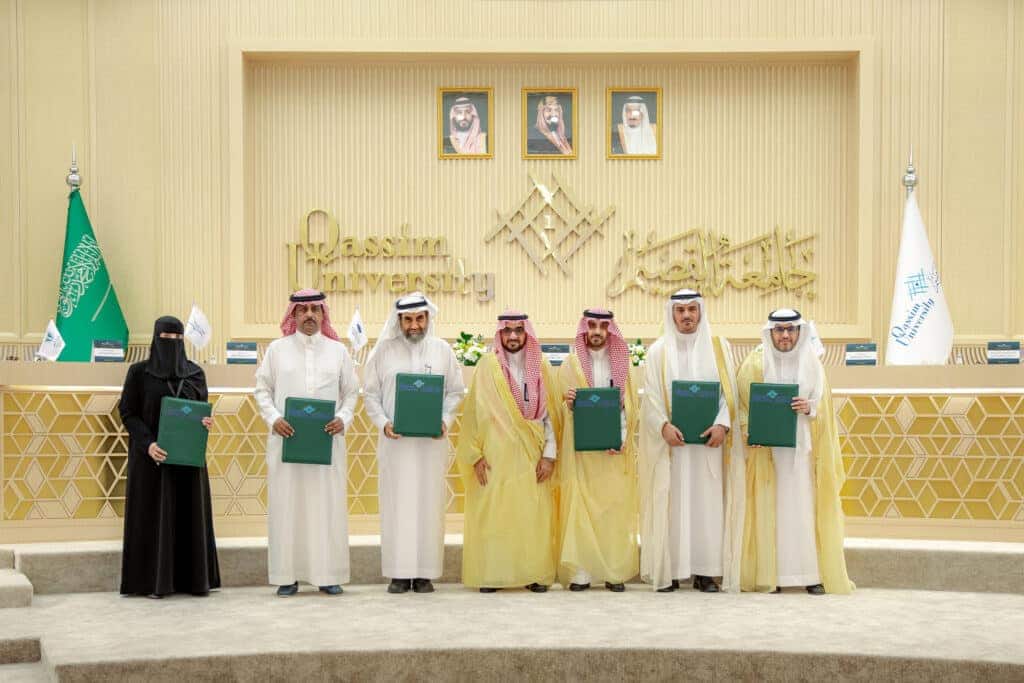
In order to enhance integration between governmental and private higher education institutions, Qassim University signed a multilateral Memorandum of Understanding on Sunday, Rabi' al-Thani 26, 1447 AH, at the King Abdulaziz Center for Conferences, with private universities and colleges in the Qassim region. This included Future University, Sulaiman AlRajhi University, Buraydah Colleges, Al-Ghad Colleges for Applied Medical Sciences, and Unaizah Colleges. The purpose is to develop educational programs and outcomes, and to support the goals of Saudi Vision 2030 in building a competitive and sustainable educational system.
The memorandum was signed by the President of Qassim University, Prof. Dr. Mohammed bin Fahd Al-Sharikh, the President of Future University, Dr. Mohammed bin Saleh Al-Shatawi, the President of Sulaiman Al Rajhi University, Dr. Mohammed bin Abdullah Al-Muhaymid, the Chairman of the Board of Trustees of Buraydah Colleges, Prof. Ahmed bin Abdullah Aba Al-Khail, the Dean of Al Ghad College for Applied Medical Sciences in Riyadh and Qassim, Dr. Fahad bin Saad Al-Qarni, and the Chairman of the Board of Trustees of Unaizah Colleges, Dr. Abdullah bin Saleh Al-Shatawi.
Under the memorandum, the entities will collaborate on developing joint academic and professional programs and activating bridging pathways between different specializations and colleges. This includes transferring and exchanging best practices in digital transformation, international ranking, and institutional excellence sustainability, in line with the parties' strategic plans and enhancing integration in roles and outcomes.
The memorandum also includes organizing joint scientific conferences, seminars, and workshops, building human and professional capabilities through training and qualification programs and exchange of expertise, and enhancing research and applied cooperation in areas of common national priority.
This collaboration comes as an extension of Qassim University's efforts to build effective partnerships with higher education institutions, and to leverage their capabilities and expertise in a way that contributes to achieving sustainable development, improving academic, research, and administrative performance efficiency, and enhancing the region's competitiveness in light of national development goals.
