 Official government website of the Government of the Kingdom of Saudi Arabia




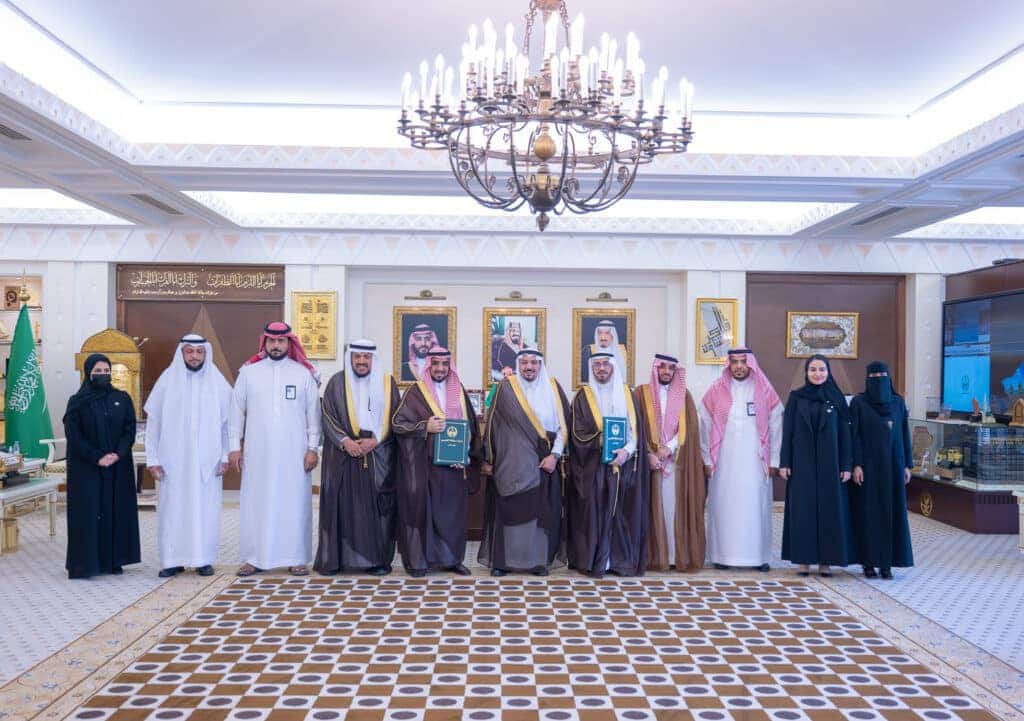
His Royal Highness Prince Dr. Faisal bin Mishaal bin Saud bin Abdulaziz, Governor of Al-Qassim Region, sponsored at his office at the Emiri Diwan Headquarters today the signing of a Memorandum of Understanding between Qassim University and the King Salman Global Academy for Arabic Language, within the framework of the university's efforts to consolidate its partnerships with national academic institutions and promote institutional integration in various fields.
The University of Qassim was represented by its president, Professor Dr. Mohammed bin Fahad Al-Sharih, while the Academy was represented in signing the memorandum by its Secretary-General, Professor Dr. Abdullah bin Saleh Al-Wushmi.
His Highness the Governor of Al-Qassim region blessed the signing of the memorandum of understanding, emphasizing that the Arabic language represents a cornerstone of the Kingdom's cultural and civilizational identity and receives great care and attention from the wise leadership – may God support them. He pointed out that these qualitative partnerships contribute to strengthening the presence of the Arabic language academically, intellectually, and technologically, and support the research and development pathways associated with it.
His Highness emphasized the importance of integration between universities and specialized institutions in serving the Arabic language, which contributes to developing quality programs and initiatives, empowering generations with the tools of knowledge and language, and strengthening the position of Arabic globally, especially in light of its growing presence in the fields of technology and artificial intelligence.
His Highness the Emir of Al-Qassim Region also praised the efforts of King Salman Global Academy for Arabic Language, and the work and initiatives it undertakes to serve the Arabic language and promote its spread, affirming that Al-Qassim University represents a distinguished academic model in supporting the Arabic language, its teaching, and related scientific research.
For his part, the President of Qassim University affirmed that the teaching, education, and care of the Arabic language are among the university's top priorities, as it represents the hallmark of our civilization and culture. He praised the efforts of the King Salman Global Academy for Arabic in serving the Arabic language, which underscores the attention and care of the wise leadership - may God protect them - for this language.
It was pointed out that the university works to support scientific research related to the Arabic language, in addition to teaching and educating Arabic to international students representing more than 90 nationalities from various countries around the world, which contributes to spreading Arab culture and introducing the civilizational achievements it has presented to the world throughout the ages.
For his part, the Secretary-General of the Academy explained that this partnership is in line with the vision that the Academy is pursuing in building bridges of cooperation with leading academic institutions and employing their potential to serve Arabic and develop its presence. He emphasized that this comes with continuous support from His Highness Prince Badr bin Abdullah bin Mohammed bin Farhan Al Saud, Minister of Culture and Chairman of the Academy's Board of Trustees, and in alignment with the objectives of Saudi Vision 2030.
He pointed out that Qassim University, with its scientific competencies and advanced research environment, is a qualitative partner capable of enriching joint work and making a tangible impact in the linguistic and cognitive fields.
The memorandum aims to activate the role of the strategic partnership between the two parties, and to utilize their capabilities and expertise to achieve mutual interest, by establishing a general framework for joint work, activities, and tasks in areas related to the Arabic language, which supports the exchange of expertise, contributes to the development of qualitative programs and initiatives, and enables the use of the Arabic language in its specialized fields.
Areas of cooperation include research and scientific publishing on Arabic language issues and its teaching, developing artificial intelligence tools for understanding and generating Arabic, providing university staff with access to the Academy's digital library, education and training in preparing Arabic teachers for non-native speakers and their learners, developing Arabic teaching programs, as well as activating the celebration of the International Arabic Language Day, highlighting the comprehensiveness of linguistic work and its integration between educational, technical, and research aspects.
